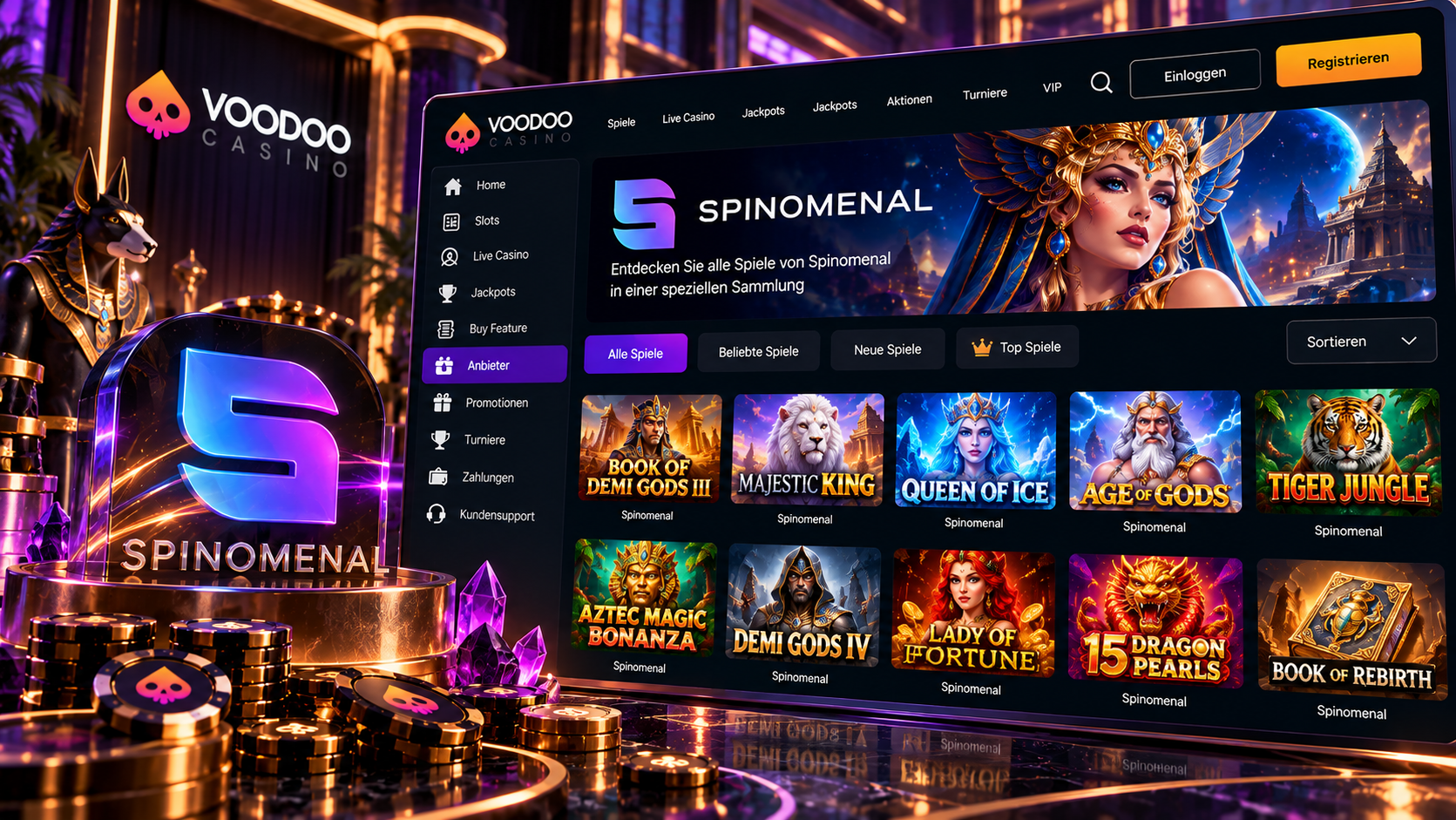
Beyond the Game Grid: Exploring a Dedicated Spinomenal Collection
A large online casino catalogue can be approached in several ways. Some visitors begin with broad categories, others look for recently added releases, while experienced users may prefer to explore games from a particular software studio. A dedicated provider page makes that last approach much easier. On the German Voodoo platform, the spinomenal section brings the studio’s titles together in one searchable catalogue rather than scattering them across the wider game library.
One Provider, One Focused Catalogue
The current Voodoo page identifies the collection as “All games (Spinomenal)” and reports 627 games in the catalogue.
That makes the page substantially different from a general casino lobby. Instead of moving between hundreds of unrelated providers, visitors can concentrate on one studio’s portfolio and browse its titles within a dedicated environment.
This type of organization becomes particularly useful when a casino has a very large overall library. A provider filter effectively creates a smaller catalogue inside the larger one, giving visitors a clearer starting point without removing access to the rest of the platform.
A Catalogue With Considerable Variety
The Spinomenal collection is not built around one narrowly defined game style. The current page begins with titles including 100 Juicy Fruits, 100 Lucky Chilies, 100 Spinning Dice, 1 Reel Baba Yaga, 1 Reel Beauty, 1 Reel Buffalo, and 1 Reel Caribbean Treasure.
Even this initial section demonstrates how broad a provider catalogue can become. Different mathematical structures, visual concepts, reel configurations, and themes can coexist within the same studio collection.
For visitors, that variety means that browsing by provider does not necessarily produce a repetitive experience. Instead, it offers another way to discover differences between individual games while maintaining a common developer identity.
Demo Access Is Visible on the Game Cards
A notable feature of the current collection is the presence of demo controls on the displayed game cards. The first titles shown on the page include a “Demo” option, allowing supported games to be opened in a free-play environment.
This gives the provider page an exploratory function. Visitors can inspect individual titles without immediately moving from browsing into real-money play.
Demo mode can also be useful when comparing games from the same studio. Instead of relying only on artwork or a title, a visitor can examine the interface and general mechanics before deciding whether a particular game deserves further attention.
Demo play should, however, be distinguished from real-money gambling. It does not reproduce the financial consequences of wagering, and a demonstration cannot be used to predict future real-money results.
“Top” Labels Add Another Layer of Information
Some games in the current Spinomenal collection carry a “Top” label in addition to their provider identification. Examples visible near the beginning of the catalogue include 100 Juicy Fruits, 100 Lucky Chilies, 100 Spinning Dice, 1 Reel – Cash Vault, 1 Reel – Classic, and 1 Reel – Demi Gods V.
These labels function as catalogue signals rather than guarantees about game performance. They help distinguish selected titles visually while leaving visitors free to explore the rest of the collection.
The combination of provider, title, demo control, and status label means that the game cards communicate several pieces of information before a visitor needs to open an individual title.
Provider Browsing Versus General Searching
There is an important difference between searching for a particular game and browsing a provider collection. A conventional search starts with something specific: perhaps a game title, category, or keyword. Provider browsing starts with the developer and leaves the visitor to explore what that studio offers.
Voodoo’s German interface supports both approaches. The wider navigation includes Slots, Live, Jackpot Games, Buy Feature, Recommended, Hot, All Games, and Popular, while provider navigation allows visitors to move into individual studio catalogues.
That gives the overall platform several layers of discovery. A visitor can approach the catalogue by game type, popularity, recommendation, or provider depending on what they already know.
A Large Studio Collection Benefits From Structure
Six hundred-plus games would already be difficult to evaluate if they appeared as one uninterrupted stream. The dedicated provider page gives the collection a recognizable framework.
The current Spinomenal catalogue is arranged as a sequence of game cards, with additional titles available through the “Mehr anzeigen” option.
This keeps the initial page from attempting to display the entire collection simultaneously. Visitors can begin with the visible selection and expand the catalogue when they want to continue browsing.
That approach is particularly relevant to large provider portfolios. The more titles a studio releases, the more important it becomes to provide a practical way of moving through them.
The Broader Voodoo Catalogue Puts Spinomenal in Context
Spinomenal is only one part of Voodoo’s much larger provider ecosystem. The current German homepage lists hundreds of providers and shows 697 Spinomenal games in its provider directory on the homepage version currently indexed.
The discrepancy between that homepage figure and the dedicated Spinomenal page’s displayed total of 627 is worth noting rather than ignoring. Catalogue counts can change as games are added, removed, or reclassified, and different site sections may update at different times.
For an article or catalogue description, the dedicated provider page is therefore the more directly relevant reference when discussing the collection linked to the supplied URL.
New Releases Can Connect With the Provider Catalogue
Provider browsing does not exist separately from the platform’s new-games system. Spinomenal titles also appear in Voodoo’s broader discovery areas when they receive the relevant labels.
The current German homepage, for example, shows Spinomenal titles including Zeus Powerstorm – Bonus Flash 3×3, 3 Chinese Charms, and Gorilla Blast – Hold & Hit 3×3, with several carrying a “new” label.
This creates an interesting relationship between two browsing methods. The new-games section answers the question of what has recently appeared, while the provider page answers the question of what the studio has available overall.
A visitor can therefore move from one discovery route to the other without leaving the wider catalogue.
Why Provider Pages Matter for Experienced Browsers
For newcomers, categories such as slots or popular games may be the most obvious starting points. More experienced catalogue browsers often develop different habits. They may recognize particular studios, follow new releases from selected providers, or want to compare a developer’s broader portfolio.
A dedicated Spinomenal page supports that type of browsing without requiring visitors to remember individual game names.
The advantage is not that one provider is inherently better than another. Rather, provider pages make the structure of a large digital casino more transparent by showing where individual games originate and allowing visitors to investigate a studio’s collection on its own terms.
Separating Catalogue Information From Game Outcomes
A provider page can tell visitors a great deal about catalogue organization, but it should not be interpreted as evidence about gambling outcomes. Labels such as “Top,” demo availability, release status, or the number of games in a provider collection do not establish that a particular title is more likely to produce a particular result.
Each game has its own rules and mechanics, and real-money outcomes remain uncertain. Visitors considering real-money play should review the individual game information and applicable terms rather than treating catalogue placement as a prediction.
This distinction is especially important when a large provider collection contains hundreds of titles. The purpose of the page is discovery and organization, not outcome forecasting.
A Dedicated Window Into a Wider Library
The Spinomenal page demonstrates why provider-based navigation has become a useful feature of large online casino platforms. Instead of asking visitors to navigate thousands of unrelated titles, it creates a dedicated window into one studio’s catalogue.
With hundreds of games, visible demo options, selected “Top” labels, and connections to the wider Voodoo navigation system, the page provides several ways to continue exploring. Visitors can examine the displayed titles, expand the collection, or return to broader categories when they want something different.
For anyone interested in how modern casino catalogues are structured, provider pages offer an informative middle ground between a single-game search and an enormous all-games library. They turn the software studio itself into a practical navigation tool while keeping the wider catalogue only a few clicks away.
Related Posts

Buy IQOS ILUMA with Delivery – Modern Heated Tobacco Technology

Cloud Computing Expands Worldwide